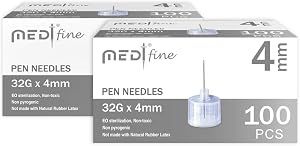
MedtFine Insulin Pen Needles 32G 4mm (5/32") 200 Pieces (2x100)
- Compatible with most insulin pens
- Triple sharpened ultra fine needle with thin wall technology that ensures better liquid flow
- EO sterilized, Non-toxic and Non-pyrogenic
- Package of 2 boxes

How to apply insulin correctly?
The Diabetes is a disease in which there is increased glucose (blood sugar). This is because the pancreas is not able to produce the hormone insulin in sufficient quantity to meet the needs of the body, or because this hormone is not able to act properly ( insulin resistance ). Insulin promotes the reduction of blood glucose by allowing the sugar that is present in the blood to penetrate into the cells to be used as an energy source. Therefore, if there is a lack of this hormone, or even if it does not act correctly, there will be an increase in blood glucose and, consequently, diabetes .
There are two main types of the disease: type 1 diabetes, in which the pancreas loses the ability to produce insulin and, consequently, it will be used in the treatment, since it is an essential hormone for the body. And type 2 diabetes, in which there is a combination of two factors - both the decrease in insulin secretion and a defect in its action (insulin resistance). Generally, type 2 diabetes can be treated with oral or injectable medications, however, over time, the disease may worsen. In this case, it will also be necessary to use this hormone, isolated or associated with medications. There is also diabetes that occurs during pregnancy (gestational diabetes) that may need treatment, including insulin, depending on each pregnant woman. This type of diabetes tends to disappear after pregnancy.
When the doctor deems it necessary to use insulin therapy, it is important that patients are advised on the type of insulin to be used (there are several types on the market), as well as on the care in its application. In recent years, there has been a breakthrough in the insulin treatment of diabetic patients. Despite these advances, some basic information for its application is still unknown to many people with diabetes, such as: ideal type of needle, location and rotation of the application sites, care at the time of insulin application, among others.
Basic guidelines for insulin application
Insulin should be applied directly to the subcutaneous tissue (layer of fat cells), just below the skin. The thickness of the skin is around 1.9 to 2.4 millimeters (mm) at the places of insulin application. As the idea is to pass it, without, however, reaching the muscles, the needles used can be 4, 5, 6 or, at most, 8 mm.
The application angle varies depending on the amount of fat in the application area. For example, in the case of a thin person with little fat in the application area, there is a greater risk of reaching the muscles when using a longer needle and application angle of 90 ° in relation to the skin surface. In these cases, it is possible to choose a shorter needle, make a skin fold (of skin) and apply at a 45 ° angle.
The skin fold is used to prevent the needle from reaching the muscles located just below the adipose tissue (layer of fat cells). This is because in the muscle insulin can be absorbed more quickly, causing hypoglycemia (marked reduction in blood sugar). It is preferable, when available, to use shorter and thinner needles. The choice of needles can follow the following recommendations:
For adults
Needles with 4, 5 or 6 mm can be used by obese and non-obese adults. In the case of 4 and 5 mm needles, it is not necessary to make the skin fold and the application angle is 90º
When needles and syringes with a 6 mm needle length are used, applications should be made at a 90º angle. However, when the application is carried out in a region with scarcity of fat (subcutaneous tissue), the skin fold and the 45º angle should be performed to avoid an intramuscular injection.
There is no medical reason to use needles longer than 8 mm.
For children and children and teenagers
Needles with 4, 5 or 6 mm can be used. There is no medical reason to use longer needles
For children under 6 years of age, it is recommended to make the skin fold with all needle lengths (4,5,6,8 mm) and angles of 90º
Children and adolescents need to make the skin fold and 45º angle with needles of 6 mm or more.
For pregnant women
The abdomen is a safe region for insulin delivery during pregnancy
Due to the thickness of the skin due to uterine expansion, pregnant women should use 4 or 5 mm needles
When needles of 6 mm in length or more are available, the application should be carried out with the skin fold and at an angle of 45º
It is prudent to perform the skin fold at all application sites
From the second trimester of pregnancy, it is recommended to use the sides of the abdomen, thigh, back of the arms and buttocks.
What are the best places to apply insulin?
- Abdomen (belly)
- Thigh (front and outer side)
- Arm (back of upper third)
- Buttocks (upper and lateral part of the buttocks).
Do I need to rotate between the application sites?
Yes, it is important to mention that there must be a rotation between the application sites, as this approach reduces the risk of complications in the application area, such as lipohypertrophy (hardened points under the skin) or lipoatrophy (depressions in the skin relief caused by fat loss).
The application sites, as well as the illustration of the correct way to make the skin fold can be viewed directly on the website of the Brazilian Diabetes Society ( http://www.diabetes.org.br ) or in the articles cited in the references. The ideal is to wait 20 to 30 days to reapply at the same point. The distance between two points of application should be about three centimeters (two fingers). In the abdomen, insulins can be absorbed more quickly than in the arms and thighs.
Step-by-step when insulin is applied:
- First, separate all of the material: prescribed insulins, syringe, needle, cotton and alcohol.
- Wash your hands thoroughly with soap and water. Then clean the application sites with cotton wool soaked in alcohol. The ideal is to use a new syringe and needle for each application. All these precautions contribute to avoid contamination and infection at the application site.
- NPH insulins and premixtures should be mixed gently, rolling the bottle between your hands approximately 20 times, without shaking the bottle, until the liquid is milky and homogeneous. This procedure is not necessary for transparent insulins.
- Clean the rubber stopper on the top of the bottles with a one-way alcohol swab.
- Aspirate an amount of air into the syringe equal to that prescribed keeping the needle covered with its plastic cap.
- Remove the needle cap and place the vial on a flat surface. Insert the needle through the rubber stopper of the insulin vial and inject the air inside the syringe into the vial.
- Turn the vial upside down and draw in the prescribed amount of insulin. If there are bubbles in the syringe, inject the insulin back into the vial and repeat the procedure.
- Remove the needle from the vial.
- Clean the chosen area by wiping the alcohol-soaked cotton over the skin in one direction only. After passing the alcohol, do not apply the insulin until the skin is completely dry.
- With the syringe between your fingers, as if it were a pen, you must make a quick movement towards the skin (throwing a dart) at an angle of 90º or 45º as directed. Make the skin fold when necessary. Insulin injection should be done slowly. Applying insulin at room temperature helps to reduce pain during application. The ideal is to remove the insulin vial from the refrigerator 15 minutes before application.
- Remove the needle from the skin and press the spot gently with a dry cotton pad. Massage should not be done on the application area, as this can increase blood flow and alter the absorption of insulin. Immediately cover the needle with the cap to prevent contamination from accidents.
- The use of the pens must be carried out according to the instructions of the manufacturer of each one of them. Its use should be restricted to only one patient. Needles should be immediately disconnected from the pen and discarded after application and used only once to avoid contamination and infection. After insulin is applied, count to 10 (ten seconds) to remove the needle. When larger doses are applied, it may be necessary to count up to 20 seconds to prevent part of the insulin from returning to the skin surface when the needle is removed. This count is not necessary for syringe application.
Regular insulin should preferably be applied to the abdomen to increase the absorption rate, while NPH should be applied, preferably, to the thighs or buttocks, to delay absorption and reduce the risk of hypoglycemia. The appearance of ecmoses (purple spots) is common at the site of insulin application. They are due to blood leakage when blood vessels are punctured by the needle.
These guidelines are important, however, not sufficient for all patients, depending on the peculiarities of each case. If your question has not been clarified here enough, ask your endocrinologist. The education of patients with diabetes is of fundamental importance in order to achieve good glycemic control. Thus, it is important that education be continued, with periodic reviews, as the inadequate application of insulin can cause hyper or hypoglycemia (increase and decrease in blood glucose), that is, result in poor disease control and, consequently, in increasing the risk of complications.

No comments:
Post a Comment